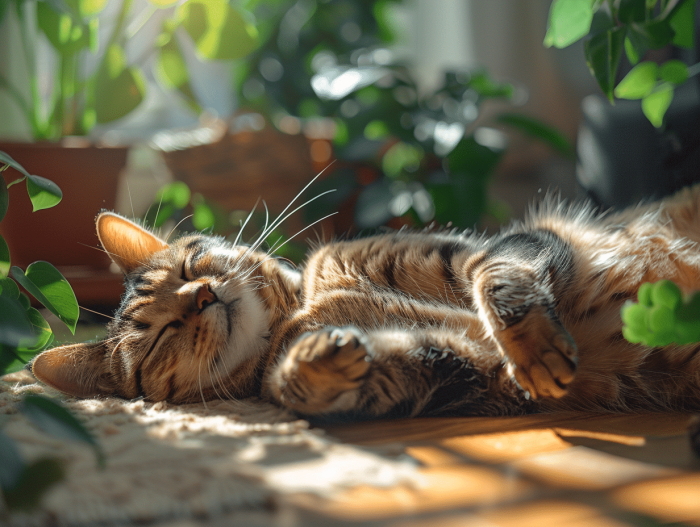
Cats communicate subtly, often using their body language. Cat owners are regularly faced with the puzzle of what these creatures are trying to express. A purr, for example, can signify contentment or pain, while a sigh might indicate relaxation or frustration. Decoding these signals allows for a better understanding and care of our four-legged companions. For cat lovers, learning to interpret these physical manifestations is essential to strengthen the bond with their pet and ensure a harmonious coexistence.
The keys to understanding your cat’s body language
Cats, as primarily non-verbal animals, use body language to express a range of emotions and needs. A global body language includes signs such as half-closed eyes and relaxed ears, which are often indicators of relaxation and contentment. An attentive owner can decipher their feline’s moods, whether it be contentment, discontent, frustration, boredom, pain, discomfort, or stress.
Ordinarily, a sighing cat is a cat expressing a feeling of relaxation or contentment. This sigh, often observed alongside half-closed eyes and relaxed ears, can, however, take on other meanings, such as emerging frustration or the sign of deep boredom. Staying vigilant to these nuances is fundamental for the animal’s well-being.
The cat’s sigh can also be synonymous with pain or discomfort, especially if other unusual behaviors are observed. If your feline shows sudden changes in behavior or repeated sighs, it is necessary to consult a veterinarian to rule out any underlying health issues. Animal health professionals are equipped to assess your cat’s health and provide appropriate treatment if necessary.
In your role as a vigilant guardian, observe the toys and activities that stimulate your cat, and ensure that its living space offers a calm and secure environment. A space should maintain a good temperature and eliminate any unpleasant odors, so the cat can feel comfortable and avoid stress. This attention to the cat’s immediate environment is a fundamental aspect of correctly interpreting its body language and responding to its needs.
From observation to interaction: how to respond to your feline’s signals
Carefully observing your cat’s behavior is the first step to understanding its needs and emotions. When faced with a feline showing signs of relaxation – half-closed eyes, relaxed ears – the most appropriate reaction is to respect its space while offering the possibility to interact if it desires. Respecting these special moments is a guarantee of trust and mutual understanding between the animal and its guardian.
When a cat expresses signs of discontent or frustration, through sighs or tense body language, the appropriate reaction is to seek to identify the cause of its discomfort. Is it a change in its environment, a lack of activity, or physical pain? The answer to these questions can often be found by observing changes in its living space or daily routine.
A cat suffering from a disease or injury may also show significant behavioral changes. If these signals persist or are accompanied by other symptoms, consulting a veterinarian becomes essential. This health professional will assess your pet’s health and can provide appropriate treatment, thus ensuring its well-being.
It is essential that the living space of the cat offers an environment conducive to its flourishing. A calm and secure space, a good temperature, and the absence of unpleasant odors form the basis of a healthy habitat for the feline. Stimulating toys and activities are also necessary for its physical and mental well-being. By responding attentively and carefully to your feline’s signals, you will foster a harmonious and balanced relationship.