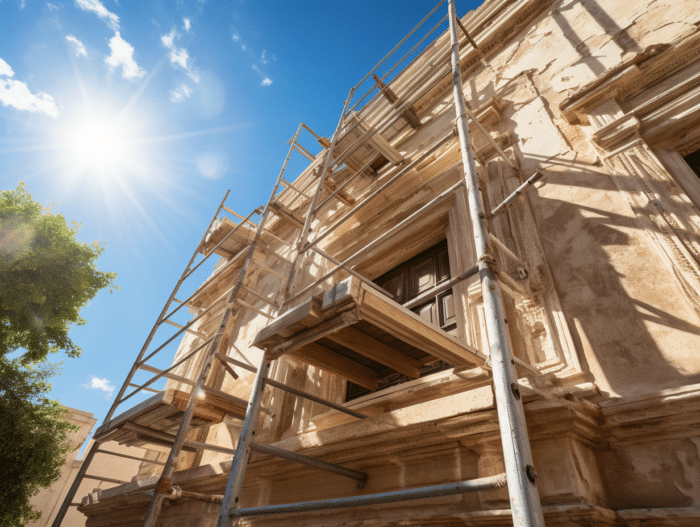
The renovation of facades of old buildings represents a major challenge for architects and restorers. This meticulous work must reconcile the preservation of architectural authenticity with compliance with current safety and insulation standards. The choice of colors plays a fundamental role, as it must both correspond to the original materials and integrate harmoniously into the urban or rural landscape. The selection of colors often has to comply with local regulations or recommendations from the Bâtiments de France, particularly in protected areas, where aesthetic and historical harmony is paramount.
Compliance with Standards in the Renovation of Old Facades
Facade renovation: this term encompasses a technical reality governed by a set of strict rules, among which the DTU (Document Technique Unifié) standards and the rules of the trade hold a prominent place. These are essential to ensure the longevity of the work and the respect of the architectural characteristics of old buildings. Any facade renovation project must meet these requirements, guaranteeing not only the quality of the work but also its compliance with urban and heritage regulations.
The Local Urban Plan (PLU) plays a decisive role in defining the colors authorized by the Bâtiments de France for facades. These often must conform to historical or regional shades, thereby preserving the visual identity of the location. The Council for Architecture, Urbanism, and the Environment (CAUE) can also intervene in this process, advising owners on relevant choices to enhance heritage while meeting environmental integration objectives.
Administrative authorizations are an essential step before undertaking any facade renovation. A prior declaration of work is often required, especially for modifications that change the exterior appearance of a building. In protected areas or for historical monuments, the constraints become heavier: it is then necessary to obtain the approval of the architect of the Bâtiments de France, who will ensure that the proposed work respects the specificities and integrity of the building concerned.
Choosing Colors for Old Facades: Criteria and Recommendations
Choosing a color for the facade of an old house requires particular attention to historical and cultural details. Colors vary by region and local regulations, often dictated by the Local Urban Plan aimed at preserving the traditional aesthetics of neighborhoods. However, the color palette is not limited to a mere reproduction of the past; it can also be part of a contemporary enhancement of heritage.
In this context, the criteria for choosing materials are crucial. The shades must harmonize with the original construction materials and respect the characteristic hues of the time when the building was constructed. It is advisable to consult municipal archives or experts in heritage renovation to ensure that the color selection is faithful to the building’s history.
Owners considering a renovation project may benefit from financial aid, especially if the work contributes to the energy improvement of the building. It is therefore wise to inquire with the relevant services to know the available grants and eligibility conditions, particularly for work carried out by RGE (Reconnu Garant de l’Environnement) professionals.
The quality of the coating applied plays a fundamental role in the aesthetics and durability of the facade. Choosing quality coating materials that are suitable for climatic conditions and respectful of the original appearance of the facade is an essential step in the renovation. Facade renovation professionals are able to advise on the best options, balancing conservation imperatives with performance and aesthetic expectations.