
Getting around from Rognac involves juggling several modes of transport with very different logics. Metropolitan bus, VTC, taxi, personal vehicle, or on-demand transport: each option has its own rates, frequencies, and constraints. This article measures the concrete differences between these solutions to identify which one best meets each common use in the Berre lagoon area.
Cost, frequency, and flexibility: comparative table of transport in Rognac
Before detailing each mode, a synthetic overview allows us to situate the structural differences. The data below reflect the observable characteristics in the Rognac – Vitrolles – Marseille Provence area.
| Mode of transport | Indicative cost per trip | Availability | Main constraint |
|---|---|---|---|
| Metropolitan bus (Lebus 8, 11, 12) | Low (metropolitan pricing) | Monday to Saturday, fixed hours | No service on Sundays, limited hours |
| VTC (Allocab, Uber) | Variable depending on time and demand | 24/7 | Price not guaranteed during peak hours |
| Taxi | Regulated meter fare | By reservation or at the station | Random availability in suburban areas |
| On-demand transport (Lebus+) | Low (metropolitan pricing) | By prior reservation | Limited slots, reservation required |
| Personal vehicle | Fuel + maintenance + parking | Permanent | High fixed cost, parking at destination |
This table reveals a recurring pattern: the cheapest mode is also the least flexible. The metropolitan bus remains the most economical solution for regular trips to Vitrolles or Berre-l’Étang, but its hours do not cover Sundays or evenings.
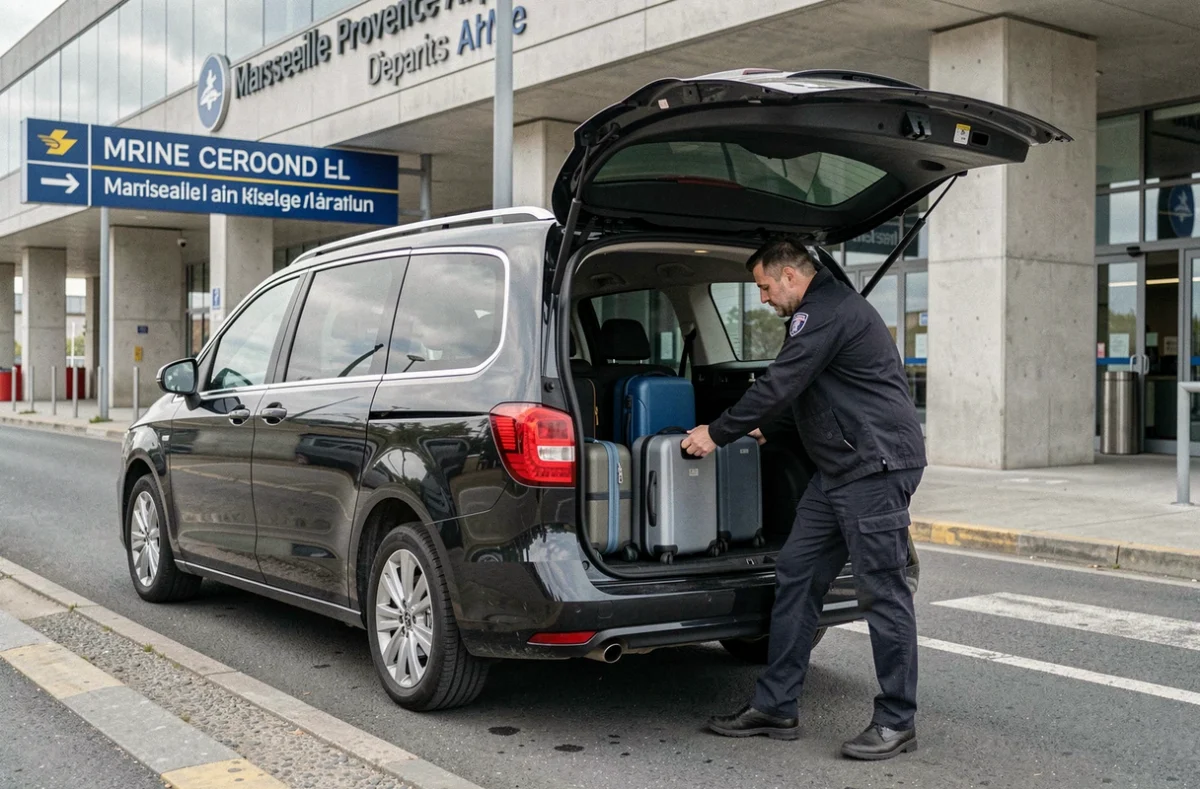
The transport services with Rognac Auto provide an interesting alternative for trips that fall outside the public network’s schedules, particularly for business travel or transfers to Marseille-Provence airport.

Marseille-Provence airport connection from Rognac: variable price vs fixed hours
The proximity of Marseille-Provence airport constitutes a frequent use case for Rognac residents. Several options coexist, but their pricing logics diverge significantly.
The bus network does not offer a direct link between Rognac and the terminal. One must transit through Vitrolles, which lengthens the travel time and requires adhering to sometimes tight connections. For an early flight, this solution becomes impractical.
VTC platforms like Allocab or Uber offer a short trip between the airport and Rognac. Allocab guarantees a fixed price day and night, with reservations possible up to a year in advance. Uber, on the other hand, applies dynamic pricing: the price varies depending on the time and level of demand. Therefore, the same trip can cost significantly more on a Friday evening than on a Tuesday morning.
The taxi remains a regulated option with a meter fare, but availability at the station in Rognac is not always guaranteed. Phone reservations are required in most cases.
What the price doesn’t say
Beyond the displayed price, two criteria weigh in the choice of airport transport: schedule reliability and management of unforeseen events. Allocab, for example, offers automatic rescheduling in case of flight or train delays. This type of guarantee does not exist with a traditional taxi or the bus network.
Metropolitan pricing evolution: what changes in November 2026
The pricing context for public transport in the Aix-Marseille-Provence metropolis is in motion. According to Marsactu, a new pricing grid was presented on October 13, 2026, and was to be submitted for a vote by the metropolitan council on October 15, with implementation scheduled for November 1, 2026.
The article reports that the majority of users would pay more with this new grid. However, people in precarious situations would benefit from reduced fares. This evolution changes the economic equation for regular commuters from Rognac who use the Lebus or Zenibus lines.
For occasional trips (airport, one-off trips to Marseille), this increase reinforces the interest in a systematic comparison between public transport and VTC. For infrequent trips, the price gap between a bus ticket and a VTC ride can narrow if one considers the time for connections and the cost of feeder trips.
Rail link Rognac – Aix-en-Provence: a local demand without response
An article from Head Topics dated October 16, 2026, reports the launch of a petition for a direct rail link between Rognac and Aix-en-Provence. Currently, this trip requires a connection, which significantly lengthens the travel time and discourages train use for commuting.
This mobilization illustrates a blind spot in the transport network around Rognac: connectivity to Aix-en-Provence, the second employment hub in the department, remains insufficient by rail. Current alternatives boil down to three options:
- The personal vehicle, with travel time depending on traffic on the D113 and A51, and a high overall cost (fuel, tolls, parking)
- Carpooling, which requires finding a driver at the same times and whose regularity is not guaranteed
- The VTC or taxi, whose cost per trip makes daily use difficult to sustain
As long as this direct link does not exist, Rognac residents working in Aix-en-Provence remain largely captive to individual cars.
On-demand transport Lebus+: a niche solution in Rognac
The Lebus+ service from Métropole Mobilité operates by reservation and serves areas poorly covered by regular lines. In Rognac, it allows access to stops or neighborhoods far from the center without a personal vehicle.
Its fare remains aligned with the metropolitan grid, making it the cheapest option for nearby trips. The trade-off is clear: advance reservation is required, slots are limited, and the service does not cater to last-minute needs.
For elderly or mobility-impaired individuals, on-demand transport offers an advantage that neither the bus nor VTC can easily replicate: home pick-up. This point remains underestimated in most comparisons.
The choice of a mode of transport in Rognac depends less on the raw price than on the combination of frequency, flexibility, and reliability. A daily trip to Vitrolles is not resolved in the same way as an airport transfer at 5 a.m. The new metropolitan pricing grid, if adopted, will further redistribute the cards for regular users of the public network.