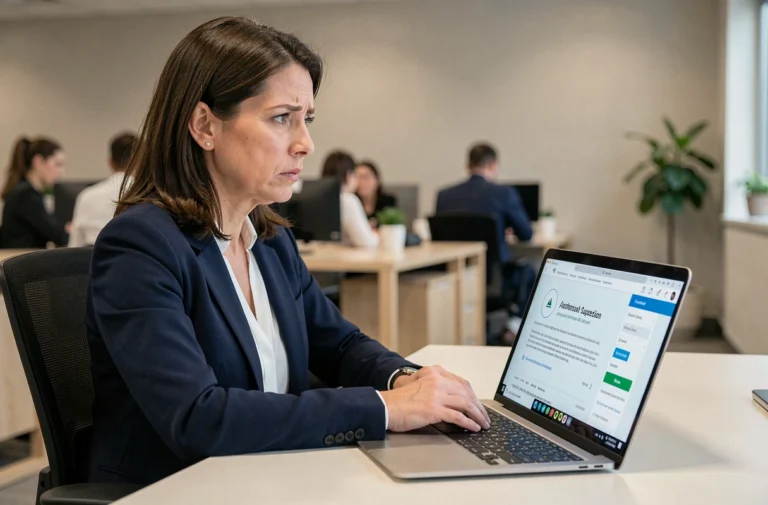
Your employer uploads a PDF file to an online space every month, and you receive an email inviting you to consult it. This document is your dematerialized payslip. But does it really hold the same value as the paper version you used to receive? The answer lies in a few specific legal texts, and the Arkevia platform is directly involved.
Employee’s Right to Opposition on Arkevia: A Often Misunderstood Guarantee
Before 2016, an employer had to obtain the explicit consent of the employee to provide a payslip in electronic format. The Labor Law reversed this logic: the employer can now opt for the digital version without prior agreement.
However, the employee is not deprived of choice. The right to opposition remains open at all times. At any moment, you can request a return to the paper format, and your employer is obliged to comply. This principle applies unconditionally on Arkevia as well as elsewhere.
There is no time limit governing this request. Whether you exercise it from the first month or after five years of using the digital safe, the result is the same. Many employees are unaware of this, as the information provided during the transition to the Arkevia online payslip is sometimes summarized in a simple letter or email.
Legal Compliance of a Digital Safe for Payslips
A dematerialized payslip only has value if the system storing it meets specific technical conditions. The Labor Code requires a long retention period and a format that preserves the integrity of the document.
Arkevia retains documents for 50 years, well beyond the legal minimum. The service operates independently of the employer: if your company changes providers or ceases operations, your payslips remain available in your personal space.
The safe must also comply with GDPR. Access to documents is reserved for the account holder. Once a payslip is deposited, the employer can no longer view it.

Have you noticed that your MyArkevia space sometimes contains other documents besides payslips? Employment contracts, tax certificates, training certificates: the employer can deposit various HR documents there. All follow the same security and confidentiality rules.
Employer Obligations Before Transitioning to Digital
Before the first electronic delivery, the law requires clear information to the employee. This notification must cover:
- The conditions for the availability of the payslip: platform address, retention period, file format
- The right to opposition and the procedure to revert to paper
- The possibility for the employee to retrieve their payslips and store them on another medium of their choice
An employer who omits this prior information exposes themselves to litigation. The electronic payslip retains its legal validity, but the lack of information can be invoked before the labor courts.
Accessibility of Arkevia and Union Claims on Paper Payslips
For an employee familiar with digital tools, dematerialization poses little difficulty. The picture changes when considering individuals without reliable internet access, those uncomfortable with web navigation, or those working in low-digitized sectors (construction, agriculture, home care).
Unions like the CGT denounce these accessibility gaps. Their position: imposing a digital safe like Arkevia primarily penalizes employees who are furthest from digital technology, often the least qualified.
These organizations use the individual right to opposition as a collective lever. By encouraging employees to demand a return to paper en masse, they aim to prove that the demand has not disappeared.
A Debate That Goes Beyond Simple Format Preference
The issue goes beyond the technical aspect. A payslip serves to justify income for a mortgage, a rental, or a social aid application. When an employee cannot connect, download a PDF, or print it, the digital format becomes a concrete obstacle.
The paper payslip remains a right, not a temporary option. No current text provides for the elimination of the right to opposition. Companies that present dematerialization as definitive are making a legally inaccurate shortcut.
Data Security and Legal Validity of the Arkevia Payslip
Why does a payslip stored on Arkevia hold the same value as a paper document in court or before an administration? Because the system meets three guarantees required by law:
- The integrity of the document: the PDF file cannot be modified after deposit, neither by the employer nor by the employee
- Long-term availability: retention over several decades allows retrieval of payslips long after leaving the company
- Confidentiality: only the safe holder accesses their documents, via a secure connection with username and password
In case of disputes (salary disputes, retirement calculations, compensation), a payslip downloaded from Arkevia constitutes admissible evidence. Its evidential value is identical to that of the original paper, provided the safe complies with current standards.
Employees using MyArkevia should regularly download their payslips and save them on a personal medium. Access to the service persists after leaving the company, but keeping a local copy protects against any future technical mishap.
The legal framework for the dematerialized payslip via Arkevia is based on a simple principle: the employer chooses the format, the employee has the final say. As long as this right to opposition exists, dematerialization remains one method of delivery among others, not an obligation imposed.