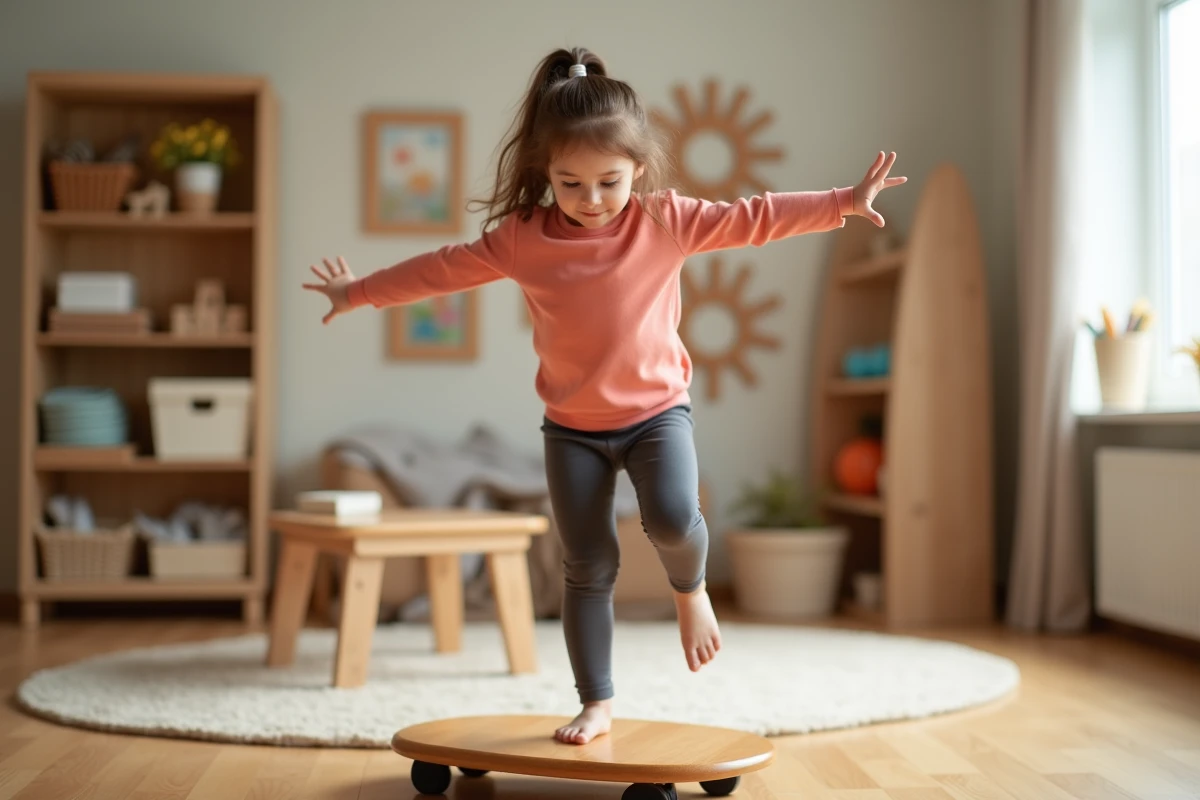
A child standing on an unstable surface simultaneously engages their ankles, hips, eyes, and inner ear. The balance board replicates this situation on a small scale, in a safe environment. Its principle is simple: a curved wooden board, without a motor or screen, that forces the body to constantly adjust to avoid tipping over.
This adjustment mechanism stimulates the vestibular system, the sensory network located in the inner ear that informs the brain of the body’s position in space. When this system is well-stimulated, posture, coordination, and even concentration improve. You can delve deeper into the topic of vestibular exercise on Douceur Enfance to understand the links between balance and learning.
Joint overload in hyperactive children: adapting the use of the balance board
You may have noticed that a very active child tends to use a toy far beyond what their body can tolerate? With the balance board, the risk exists. The joints of the ankles and knees absorb every micro-postural correction. During a short session, the load remains beneficial. In repeated and prolonged sessions, it can become excessive, especially in hyperactive children who do not always feel muscle fatigue.
Physiotherapists working in therapeutic workshops report that limiting sessions to ten or fifteen minutes is sufficient to obtain motor benefits without causing joint discomfort. For a child who moves a lot, it is better to break up the use into several short sequences throughout the day rather than allowing a continuous hour.
Some preventive adaptations reduce the risk:
- Place the board on a soft mat to absorb vibrations transmitted to the joints and limit the risk of slipping
- Alternate postures on the board (standing, kneeling, sitting) to distribute mechanical stresses across different areas of the body
- Observe the child: if they start to compensate by excessively leaning to one side, it is a sign that their stabilizing muscles are tiring
This vigilance does not concern the majority of children. But for those who exhibit a marked profile of motor agitation, support from a healthcare professional helps calibrate the duration and intensity.
Bilateral coordination and proprioception: what the board concretely trains
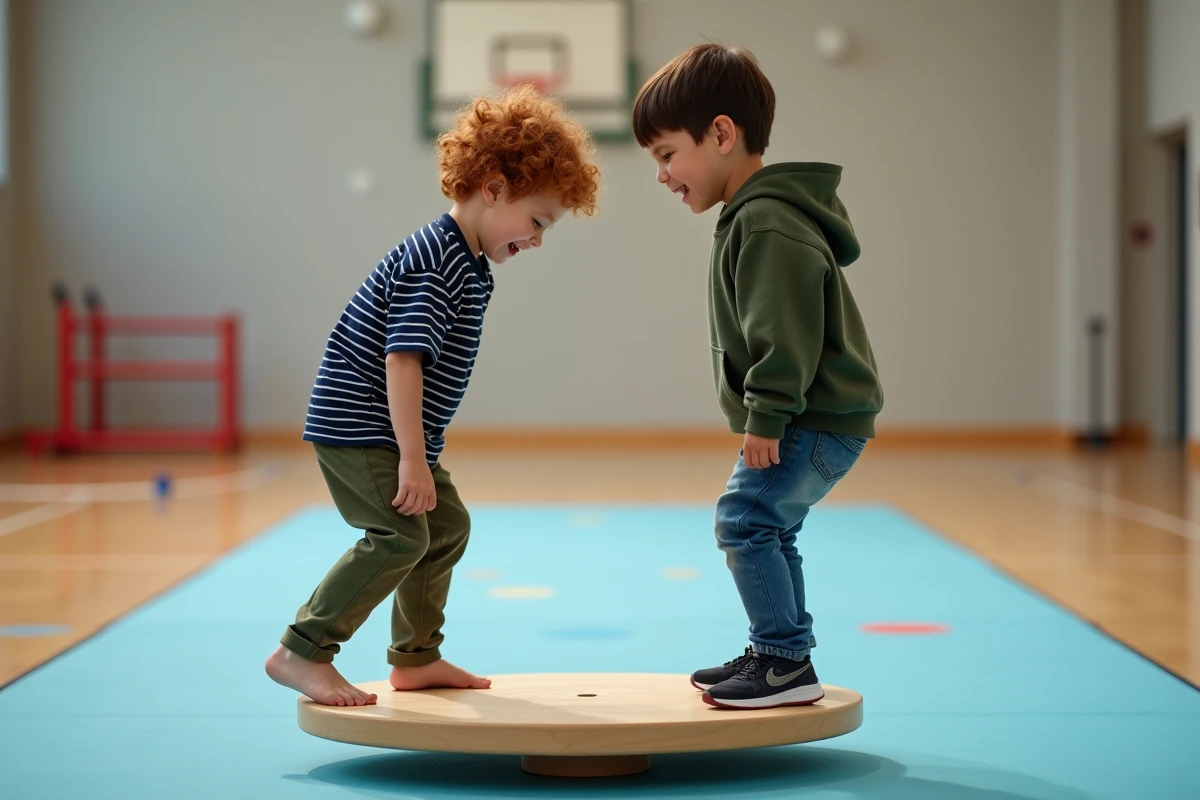
Bilateral coordination is the ability to use both sides of the body in a synchronized manner. Pedaling, cutting with scissors, catching a ball: all these actions rely on it. The wooden balance board trains this skill because it requires the brain to simultaneously coordinate the left and right supports.
Feedback from physiotherapists observes a notable improvement in bilateral coordination in dyspraxic children after eight weeks of daily use. Dyspraxia is a disorder that complicates the planning of movements. On the board, the body learns through trial and error to adjust its supports, without complex verbal instructions.
Proprioception, or the perception of the position of one’s limbs without looking at them, also progresses. A child who regularly practices on a board develops a better sense of their body in space. Concretely, this translates into fewer clumsiness in daily life: fewer falls on stairs, better pencil grip, a more stable posture while sitting in class.
Montessori balance board: why wood and simplicity matter
Montessori programs increasingly integrate the balance board in classes for ages 3 to 6, particularly in Europe. The reason lies in the very philosophy of the pedagogy: the child learns through free movement, without directive intervention from the adult.
A passive wooden board imposes no play scenario. The child decides: they can rock, turn it into a bridge, or lie on it to read. This freedom stimulates imagination and extends playtime. Parents surveyed in recent comparative studies prefer wooden boards to electronic vibrating platforms for their durability and lack of dependence on a power source.
Safety criteria to check before purchase
Since January 2026, the updated European directive EN 71-1 imposes enhanced testing on wooden balance toys, covering slip risks and small parts. Before purchasing, check that the board bears the CE marking in compliance with this recent standard.
- Non-slip coating on the upper surface: pressed felt or grooved wood
- Rounded edges and board thickness suitable for the child’s weight, generally indicated by the manufacturer
- Certified wood (FSC or equivalent) and solvent-free finish, especially for those under 3 years who put everything in their mouths
- Clearly indicated maximum load: a quality board can also support an adult’s weight, allowing for shared play
Gross motor skills and stability: benefits that go beyond play
Gross motor skills encompass movements that engage the entire body: running, jumping, climbing. The balance board acts as an accelerator for these skills because it forces the deep trunk muscles to work continuously. These muscles, known as stabilizers, are the ones that maintain an upright posture.
A child with toned stabilizers tires less when sitting. They need to move less in their chair during class. The link between body balance and sustained attention has been documented in psychomotricity for several years. Therefore, working on trunk stability on a board has repercussions that extend beyond the playroom.
At what age to start
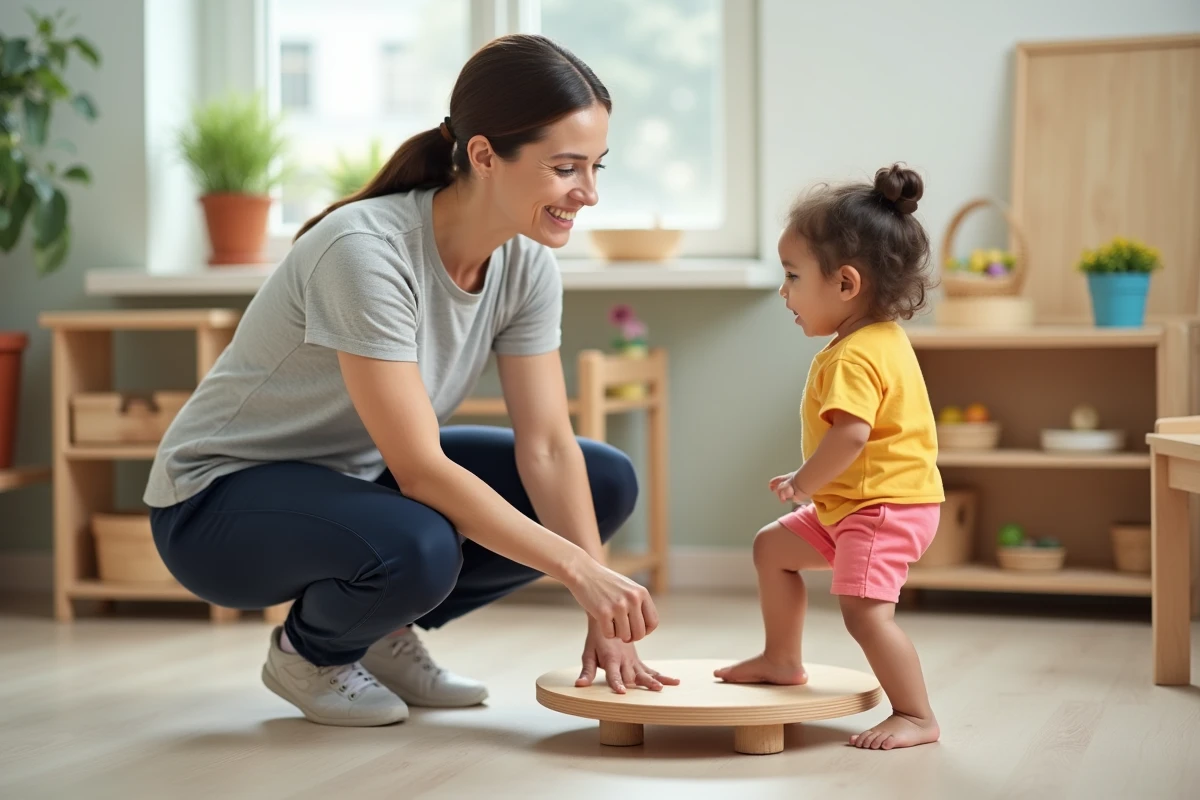
Most manufacturers recommend starting around 18 months under supervision, with a model that has a low curvature. By age 3, the child can use a standard Wobbel-type board with relative autonomy. Adult supervision remains necessary until the child masters getting on and off independently.
After age 6, the board becomes a support for more elaborate exercises: one-legged positions, squats, two-player games. The object grows with the child, making it a sustainable investment over several years of motor development.
The balance board requires neither batteries nor a manual to fulfill its role. Its strength lies in the physical constraint it imposes on the body, a constraint that the brain transforms into skill. The only serious point of vigilance remains the dosage, particularly for children with intense motor profiles, where short and varied sessions protect the joints without sacrificing benefits.